Curriculum

Opinion: Thousands of California kids with dyslexia deserve better reading instruction
Opinion Piece as published in the Times of San Diego on April 5, 2025 written by Frida Brunzell, Decoding Dyslexia CA’s San Diego Support Group Leader

I adopted my son Sebastian at birth. He was a bright, curious little boy who hit all the milestones early and loved learning about the world. So when school began, I expected he would do well. But the moment he started kindergarten, it became clear that something wasn’t right.

Sebastian was one of the only children in his kindergarten class who couldn’t write his name. His teacher encouraged me to work on letter sounds at home because he was struggling to remember them. He was only six years old, but the joy he had once shown for learning quickly began to fade. He became withdrawn, anxious, and didn’t want to go to school.

I tried to help him at home. But instead of reading, he memorized the stories. When he didn’t know a word, he guessed — just as thousands of children are currently taught to do in classrooms across California. No one told me this approach wasn’t working for him. And no one told me that there was another way to teach reading: an approach informed by the science of how the brain learns to read.

When his school finally recommended placing him in a special day class in the third grade, I agreed — because nothing else had worked. But nothing changed. He still couldn’t read. His writing was illegible. He started falling behind in other subjects, as well. This was the darkest year of our lives. I feared we were going to lose him entirely.

Eventually, we learned that Sebastian was one of the nearly one million students in California with dyslexia. I discovered through my volunteer efforts with Decoding Dyslexia CA that students with dyslexia are uniquely susceptible to poor instruction and experience the effects of poor instruction the most profoundly.

My son ultimately learned how to read, but he still sees those early childhood years as wasted time. Now, years later, Sebastian still hasn’t found his footing as a young adult. He graduated from high school in 2024 and went on to community college. Sadly, he dropped out of community college after a few weeks, and has had a few short-term jobs since. His self-esteem issues from elementary school have followed him into his adult life.

Sebastian’s story is heartbreaking, but it’s not rare. There are thousands of students across California right now preparing to graduate high school without being strong readers, which will trickle into their adult life as they navigate a literate world. How do we expect our children to become productive members of society if they can’t read a job description, a prescription label, or a ballot?

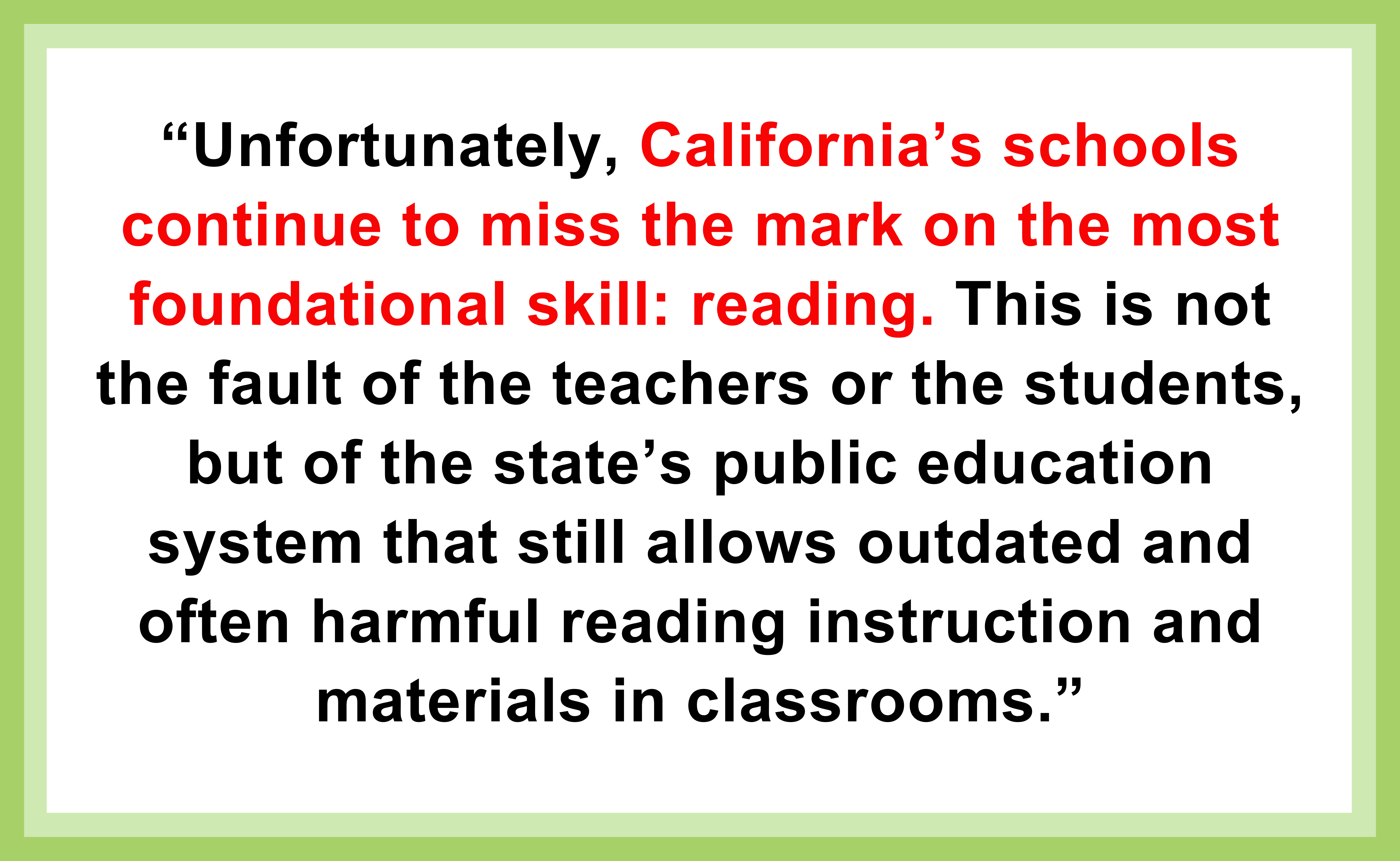
Teachers are working diligently to provide our children with the skills they need to become productive, successful adults. Unfortunately, California’s schools continue to miss the mark on the most foundational skill: reading. This is not the fault of the teachers or the students, but of the state’s public education system that still allows outdated and often harmful reading instruction and materials in classrooms.
I often wonder how Sebastian’s life would have been different if he’d received the evidence-based reading instruction needed for him to become a skilled reader. Instead of graduating high school with little confidence or direction, he might be thriving in college or at a job he loves. Instead of saying “they wasted my time” when asked about elementary school, he might be telling a story of being seen, supported, and successful.

I don’t want another family to go through what we have. That’s why I’m supporting Assembly Bill 1121, which will ensure that California teachers are trained in evidence-based methods of teaching reading.

Opinion: Thousands of California kids with dyslexia deserve better reading instruction Read More »

Free Audiobook Resources

Access to free audiobooks is a right afforded to those
with reading difficulties, including those at risk of or with dyslexia.

Do you or your child struggle with reading and want recreational audiobooks and/or classroom material audiobooks for free? If so, please read this blog!

Through various state and federally funded programs, people with reading difficulties, including those at risk of or with dyslexia, are able to gain access to two libraries of audiobooks, at no cost, for use both in and out of the classroom.

*Recreational Audiobooks*

The National Library Service for the Blind and Print Disabled (NLS) administers a free library program housing a huge collection of audiobooks for residents of the United States (and American citizens living abroad) who have difficulty reading.

What are the steps to take advantage of this free resource?

  1. Determine which NLS library you’re assigned to (based on which county you live in) at this link. Then go to your assigned library:

  2. Complete and submit an application, which can be found on the library’s website. (On the website for the Southern California option, first click on the “Become a Patron” button.)

    • If you are completing the application for yourself or as a parent or guardian of a child, a certifying authority* must attest that you or the child are unable to read the printed word due to a learning/reading disability by completing a designated portion of the application.
    • It is important to note that a student does not have to have an IEP or a 504 plan in order for a certifying authority to attest that a student would benefit from audiobooks.

  3. After your submitted application is processed, you will be provided access to the library of audiobooks one of two ways through the Braille and Audio Reading Download (BARD) service:
    • App for mobile devices: Audiobooks can be downloaded directly to the mobile device for immediate use. The app was designed specifically for ease and usability, and encompasses many helpful features.
    • USB drive (containing books) and NLS device (talking book machine): The NLS device comes with a headphone jack; and, all NLS materials and components ship through the mail for free.

If a teacher, school librarian or other public school professional would like to complete an application on behalf of students they serve, they will do so as an “institution” and will be granted the same access to the free library of audiobooks. The institution application can be found on the library’s website or by contacting the library directly.

A few additional points worth mentioning:

  • BARD continually adds to their library of over 120,000 books, including books for all ages in all genres and in multiple languages. BARD’s library also includes podcasts, cookbooks, how-to guides for coding and web design, magazines and even rulebooks for video games, just to name a sampling.
  • It’s estimated that only 5% of the eligible population is taking advantage of this free library service. The employees at each of California’s four NLS libraries are eager to spread the word and answer questions, and we encourage everyone to explore their websites and contact them for any further help you or your child may need!
  • The California School Library Association wrote a blog in 2021 discussing the services of the Northern California NLS library, the Braille and Talking Book Library (BTBL). While it covers BTBL, the services and information shared in the blog apply to all four of California’s NLS libraries.

*Classroom Material Audiobooks*

California’s Department of Education’s Clearinghouse for Specialized Media and Technology (CSMT) produces and disseminates to public schools throughout the state, at no cost, audiobook versions of textbooks, workbooks, and literature books that have been adopted by California’s State Board of Education. (If a school is using a classroom curriculum not on the state adopted list, they would have to procure and pay for the accessible materials on their own.) 

This means that students with reading difficulties, including those at risk of or with dyslexia, can be easily and efficiently provided appropriate access to their K-8 education curriculum. (High school instructional materials not included in what CSMT provides as those are a local decision and do not go through the State Board of Education adoption process.) 

Any California public school educator or personnel can apply for an account online with the Instructional Materials Ordering and Distribution System (IMODS). CSMT will review the application and once approved, their IMODS account will provide them access to all classroom material audiobooks to share with the students they serve. (As of 2024, CSMT has discontinued the creation of audiobook files due to advances in text-to-speech technology on computers and assistive devices; however, audiobook files that have already been created will remain available to download in IMODS. For any state-adopted material not already existing in IMODS as an audiobook file, CSMT will provide the publisher’s digital format of the material and it can be played on computers and assistive devices using its text-to-speech technology.)

Again, it is important to note that students do not have to have an IEP or a 504 plan in order for school personnel to determine that they would benefit from these audiobooks.

We encourage you to share these free resources with others, including your child’s school. And if you haven’t already, please be sure to sign up for DDCA emails to stay informed on all literacy-related efforts in California.

Free Audiobook Resources Read More »